Location and area
The Greenhouse Complex is located in the central area of the Ornamental sector, occupies an area of 5500 m² and comprises 21 compartments. Of these, 8 are permanently open for visits, and another 3 are accessible to visitors at certain times of the year, on the occasion of various exhibition events.
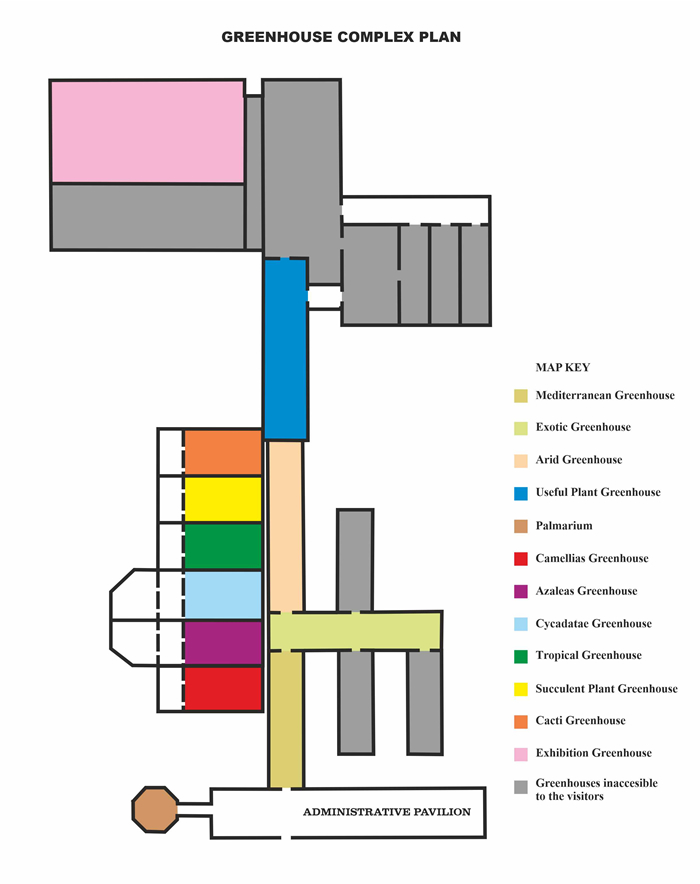
Access to the visiting greenhouses is via two routes: through the main entrance in the administrative pavilion, from where you can reach the Mediterranean greenhouse or the Palm greenhouse, or through the entrance on the alley separating the Ornamental and Phytogeographical sections. This is where you reach the Cicada, Tropical, Succulent and Cactus greenhouses. A third entrance, through the Exhibition greenhouse, is accessible to the public only on the occasion of events organized in this space.
Greenhouse Complex Plan
Description
The greenhouse complex houses about 2,210 taxa, originating in the subtropical, tropical and equatorial regions of the globe. The collections are grouped according to the geographical origin of the plants, taking into account the ecological requirements, in warm, temperate or cold greenhouses.
The collection of xerophilic plants represents a heterogeneous association of arboreal taxa, which come from areas with a subtropical Mediterranean climate. Most taxa are well-known: olive (Olea europaea), pomegranate (Punica granatum), carob (Ceratonia siliqua), oleander (Nerium oleander), rosemary (Rosmarinus officinalis), cypress (Cupressus sempervirens). Vegetation from areas analogous to the Mediterranean, located in southern South Africa is represented in the collections cultivated in greenhouses by the species Myrsine africana, Agapanthus africanus (blue lily), Haemanthus albiflos, Clivia miniata (red lily).
The flora of tropical and subtropical areas is probably best represented by woody and herbaceous species originating from the Asian, American and Australian continents.
Among the most well-known and widespread tree species in culture, they belong to the genus Ficus, generally appreciated for their decorative appearance. In the garden's greenhouses, over 150 specimens belonging to over 20 taxa (horticultural species and varieties) are cultivated: F. benjamina (weeping ficus), F. elastica (rubber ficus), F. pumila. Numerous tropical woody species are highly appreciated for the decorative appearance of their leaves: Cordyline, Dracaena, Aucuba, varieties of Codiaeum variegatum (croton), etc.
In the large group of tree species, palm trees occupy a special place, their characteristic appearance being associated with exotic areas. In the garden's greenhouses, numerous specimens of species with palmate leaves (Chamaerops humilis - dwarf palm, Trachycarpus fortunei - fan palm, Washingtonia filifera - California fan palm) or pinnate leaves (Phoenix dactylifera - date palm, Chrysalidocarpus sp.) are cultivated.
Of particular importance to specialists are the specimens belonging to the Cycadaceae family, primitive forms within the current phanerogamous plants. The most widespread species of the genus is Cycas revoluta, originating from Japan. The collection also includes other representatives of the group: Ceratozamia mexicana (originating from Central America), the African species Encephalartos ferox and Stangeria eriopus.
Exotic herbaceous plants of tropical origin known in culture for a long time come mainly from South American and Asian regions. Amateur horticulturists appreciate these plants either for their remarkable foliage in shape and color, or for their flowers that often impress with their appearance or size.
Probably the plants most loved for their foliage are ferns (Pteridophyta), which are noted either for their luxuriance (Asplenium, Nephrolepis) or for their elegance (Adiantum, Davallia, Sellaginella). In the same category of plants are species from the genera Begonia (begonia), Peperomia, Pilea, Colocasia (taro), Dieffenbachia, Monstera (ceriman), Syngonium, Tradescantia (telegraph).
Numerous ornamental plants with flowers belong to the Gesneriaceae, Acanthaceae or Araceae families. In the case of the last botanical family, the species of the genus Anthurium (flamingo flower) stand out, which have an attractive inflorescence due to the shape and color of the spadix and spathe; less well-known are the representatives of the genus Spathiphyllum (peace lily).
The collection of succulent plants includes representatives from different botanical families that have common essential characteristics that allow them to survive in arid areas: they retain and accumulate water in the vegetative organs.
The vast majority of cacti come from the desert or semi-desert regions of North and South America, the Mexican area being the richest in species. In the garden's greenhouses, the Cactaceae family presents species from the genera Astrophytum, Cereus, Rebutia, Echinocereus, Echinopsis, Opuntia, Mammillaria (represented by over 500 specimens). From the same arid American areas come representatives of the genera Agave, Yucca, Nolina, with species appreciated and cultivated for their ornamental appearance.
In areas with pluviometric deficit in Asia, Australia, but especially Africa, representatives of families that are characteristically succulent (Crassulaceae - Aeonium, Crassula, Sedum, Kalanchoe; Aizoaceae) or in which succulentness is a sporadic phenomenon (Asparagaceae - the genera Aloe or Sansevieria; Euphorbiaceae - some species of Euphorbia; Apocynaceae - the genera Stapelia or Ceropegia) develop.
Useful plants from tropical and subtropical areas are presented in different spaces and those with food uses predominate.
Among the plants from which edible fruits are used, we mention: avocado (Persea americana), carob (Ceratonia siliqua), mango (Mangifera indica), Japanese plum (Eriobotrya japonica), guava (Psidium guajava).
Other useful plant species present in the garden's greenhouses are:
-
plants that provide raw materials used in the textile industry: ramie (Boehmeria sp.), New Zealand flax (Phormium tenax), chusan palm (Trachycarpus fortunei) etc.;
-
plants with stimulating properties: coffee tree (Coffea arabica), cocoa tree (Theobroma cacao);
-
medicinal and aromatic plants: camphor tree (Cinnamomum camphora), bay laurel (Laurus nobilis), black pepper (Piper nigrum) etc.
A highly appreciated collection, which arouses the interest of visitors in the winter season (December - March), is that of azaleas (Rhododendron) and camellias (Camellia). The azaleas are represented by hundreds of specimens, mostly from about 25 varieties that have R. simsii as their parent species.
The garden's camellia collection includes specimens from 15 varieties that have Camellia japonica, C. cuspidata, C. reticulata or C. sinensis as their parent species. All specimens with horticultural value are displayed in an annual exhibition.
Theme
The Greenhouse Complex is a complement to the Phytogeographic section, as species that do not withstand the climatic conditions of our area are cultivated here. Together, the two sections manage to offer visitors a more complete picture of the flora from different biogeographical zones.